If you’ve ever groaned while creating a new account — juggling capital letters, numbers, symbols, and crazy length requirements — then you understand the pain of the inconsistent and changing password rules we’re all expected to follow.
How did we get here? lets have a look at how password security has evolved
I Like This Word, This My Word
In the early days of the internet, a password was just… a word. Your dog’s name. Your favourite drink. First Crush (No judgment here). It was simple, memorable, and for a time it worked. But quickly this became outdated and insecure. Just as now you wouldn’t dream of leaving your front door unlocked, GeorgeClooney shouldn’t even be a thought for a password anymore?
Let’s Get Creative! (Numbers and Symbols)
As security needs improved so did our rules (In theory). No longer can we just have letters but you need a number, symbol or both! Sounds good but did it work in practice? In some cases yes but realistically what happened ‘GeorgeClooney’ became ‘GeorgeClooney4’ and in reality thats not much better. So what next?
Think like a computer!
Then came the era we all know and truthfully hate uppercase, lowercase, a symbol, a minimum length. This was a true security leap along with the ability to block known phrases, personal details passwords became much harder to crack! But there was a problem..
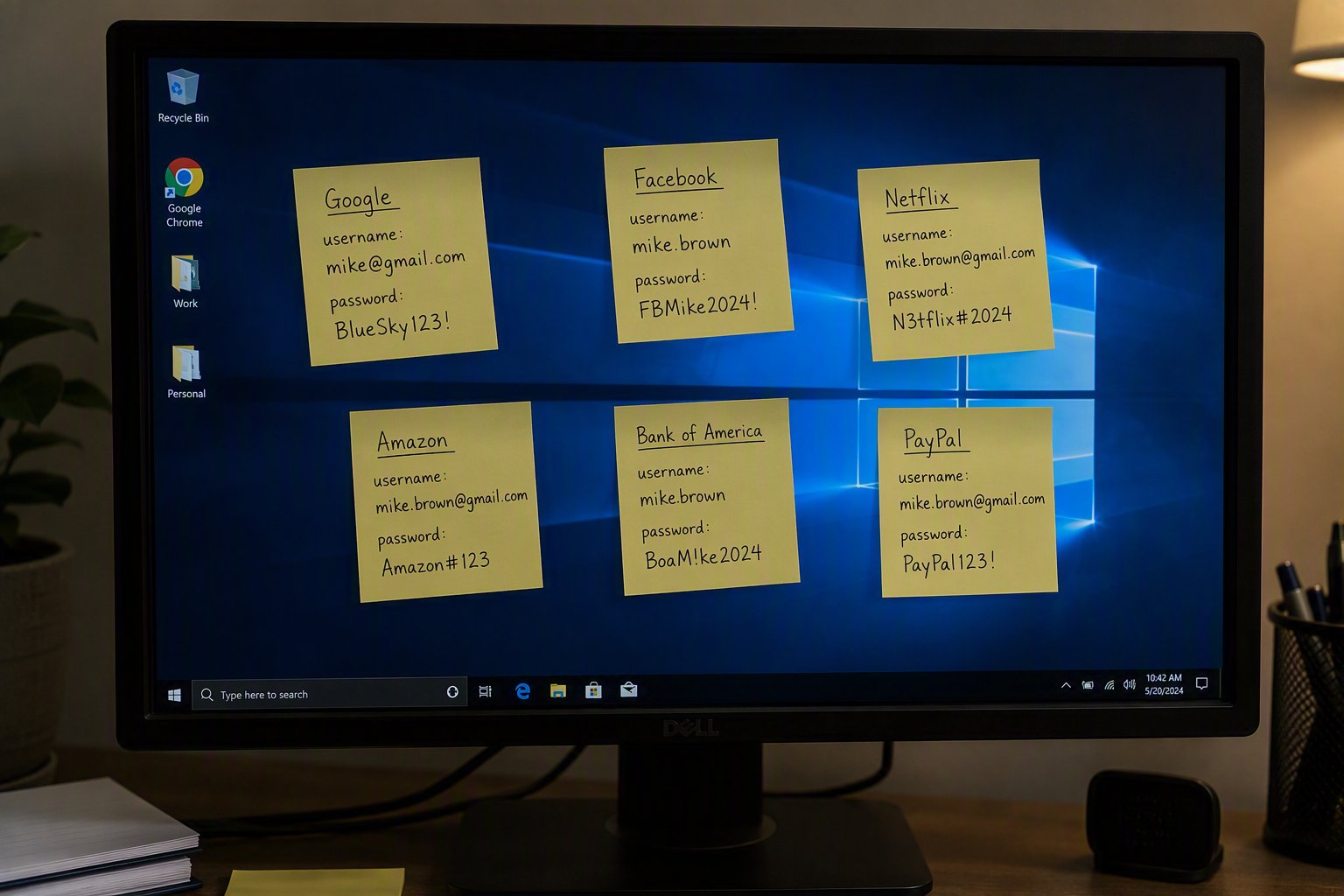
Humans aren’t built to memorize complicated sequences like T7#pL9!qZ, Nevermind change this once a month and have a different password for every account (Most people now have over 100 different accounts) So people did what people do: they wrote passwords on sticky notes, saved them in files on a computer, or reused the same “strong” password everywhere. One breach, and suddenly sharing a password for your bank and Disney + doesn’t look so good.
So how do we have passwords that are secure and memorable
Enter the Passphrase
Eventually we realised people are people. Make things too difficult and they’ll just find a way around it, so a new standard was recommended. Instead of Xk9$!, think horse-battery-lighthouse-coffee. It’s long, it’s memorable, and it’s dramatically harder to crack (Think millions of hours)— because attackers are fighting sheer length, not trying to guess a clever substitution pattern.
Passphrases finally got us a solution that is secure, and works for you and me. But… How good is your memory with 100 different passphrases (We reckon Ethan can maybe remember 15). So how can we overcome what daily live has become?
Password Managers, Sticky Notes Levelled Up
That’s where password managers stepped in — The premise? Don’t remember 100 passwords, store them in an encrypted vault, protected by 2FA (we wrote about that last week) and just remember 1 secure passphrase. Why is this better? Well the convenience is a nice perk, but if you use a password manager to store credentials. The need to re use the same password disappears. Now hackers really need a million hours to get in, and if one website you use is breached? Just change one password – not dozens.
The Future: Passwordless
And now, we’re watching the password fade out entirely. Passkeys, biometrics, and device-based authentication replace “something you remember” with “something you have” or “something you are.” There’s no special key someone can track, or spy over your shoulder. No email link with a false login that can work. Now we’re moving to a world where you enter your username, and provide something only you have… you! Making your life easier again whilst removing the ability for a hacked website to hand your password over to someone malicious.
Where This Leaves Us
The story of password security is really a story about 2 battles: security and reality. Every leap forward — passphrases, password managers, passwordless login — has come from finally accepting that people can’t out-memorize attackers, and that better security shouldn’t require superhuman effort.
The best security isn’t the kind you have to fight to use. It’s the kind that just works.
Ready to leave passwords behind? Reach out and see how we can help!